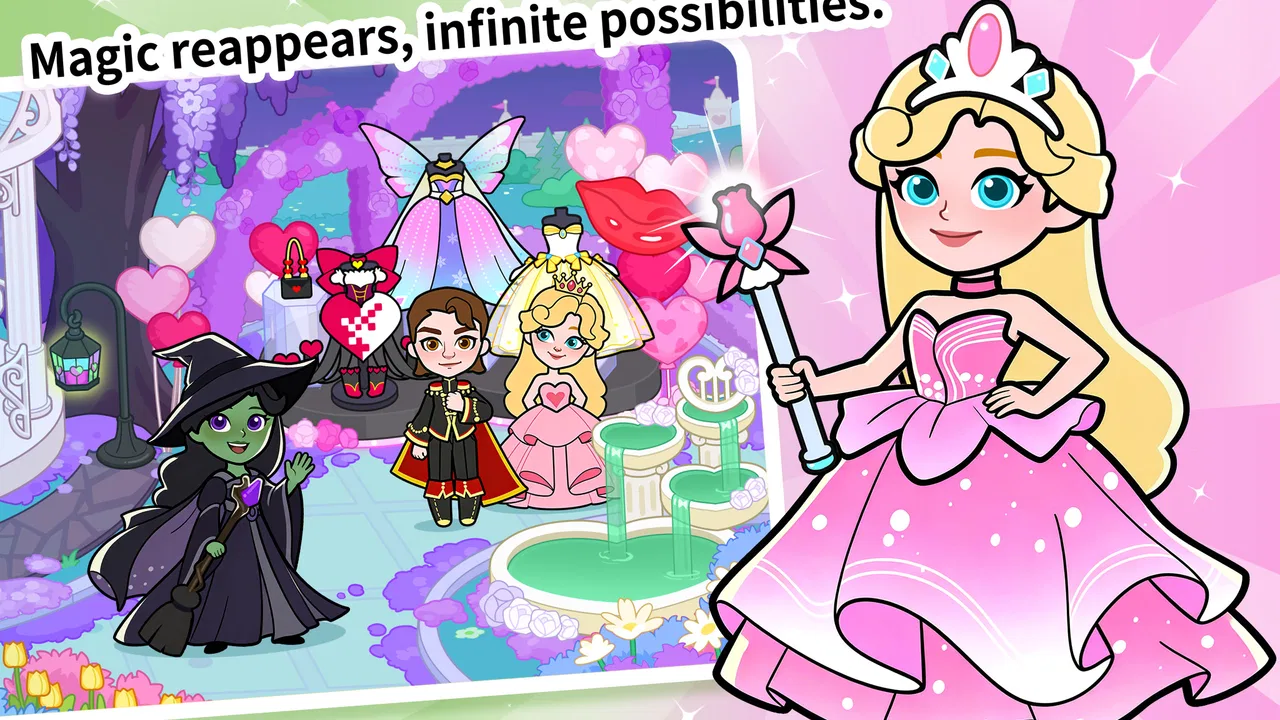
Paper Princess's Fantasy Life
- 3.7
- Rating
- 10.00M
- Installs
- Free
- Price

 Analysis by App-foxy
Paper Princess's Fantasy Life is the kind of educational game I would hand to a child who enjoys make-believe more than traditional lessons. It places the player in a colorful paper-themed world and frames learning through a fantasy routine rather than through worksheets or quizzes. I found that approach immediately approachable: the game feels like play first, while its small tasks and choices give younger players reasons to keep exploring.
That distinction matters. Many educational games announce the lesson before the fun begins, which can make children lose interest quickly. Here, the appeal comes from stepping into the life of a paper princess and seeing what the world offers next. The experience is best understood as a gentle role-playing playground for children, not as a replacement for schoolwork or a structured course. My overall impression is positive, although parents should understand that its relaxed pace and optional purchases may not suit every family.
How the fantasy setting creates early goals
The opening experience works because it gives children an easy imaginative role to adopt. Instead of asking them to master complicated controls, it invites them into Paper Princess's world and lets them learn through interaction. The fantasy framing gives ordinary activities a purpose: a child is not simply tapping through an exercise, but taking part in a princess-themed life.
You May Also Like

 Blood Strike: 2.5 Anniversary
Blood Strike’s Loadouts Turn Every Drop Into a Tactical Gamble
A close look at Blood Strike’s custom loadouts: how fast access to signature weapons reshapes its battle royale rhythm, rewards preparation, and narrows the gap between fights.

 Pandora - Music & Podcasts
Pandora’s Music Is Easy to Start, but Harder to Recover
Pandora’s strength is its low-effort path from a seed to a station. Its weak spot is how much confidence it asks you to place in connection, setup, and quiet recovery.

 8 Ball Pool
 Is Built on Rivalries, Rematches, and Routine
A close look at the rivalries, rematches, shared routines, and unanswered safety questions that turn a quick pool match into a persistent mobile community.

 Samsung Music
’s Quiet Strength Is Playing What You Already Own
Its reach comes less from spectacle than from dependable access to a personal library. That simplicity is both the app’s strongest retention engine and its ceiling.

 AccuWeather: Weather Radar
AccuWeather Review: A Quick, Clear Forecast for Everyday Decisions
For everyday plans, the best forecast is the one you can understand quickly. AccuWeather makes rain timing, radar, and local conditions easy to act on, with a few trade-offs.

 Hill Climb Racing
Why Hill Climb Racing Still Turns Crashes Into One More Run
A tiny car, a bumpy hill and one more upgrade: Hill Climb Racing keeps resurfacing because its simple chaos makes every near-miss feel personal.
More From Our News Desk



Those early goals are intentionally modest. A younger player can focus on discovering what can be touched, choosing what to do next, and understanding the rhythm of the game without facing a harsh failure state. I think this is a strong choice for children who are still building confidence with mobile games. The controls do not need to become the main challenge, so attention stays on recognition, decision-making, and imaginative play.
Parents looking for a clearly labeled curriculum should set expectations carefully. This is an educational game, but its learning value is woven into the fantasy setting rather than presented as a sequence of formal subjects. I would use it as a light activity between more focused learning sessions, especially when a child needs something calm and interactive.
The first useful tip is to let the child explore before offering help. Because the game is designed around a fantasy life, the player benefits from making choices independently. If an adult immediately directs every tap, the experience can become an instruction-following exercise instead of a small opportunity to practice curiosity and autonomy. I found that giving the child time to test the environment made the game feel more rewarding.
The developer, Libii HK Limited, has aimed the experience at a broad young audience. Its Everyone age rating supports that family-friendly positioning, though an age label alone cannot tell a parent whether the tone matches a particular child. A very young player may still need occasional guidance, while an older child who wants complex strategy may find the activities too gentle.
Progress feels visible without becoming stressful
One of the better parts of the design is the way progress is communicated through the fantasy routine. Children can see that their actions lead somewhere, even when the game is not demanding high scores or fast reactions. That sense of movement is important for retention: a player needs to feel that exploring has a result, whether the result is a new interaction, a different moment in the princess's day, or simply a clearer understanding of the world.
I would not describe the progression as deep in the way a full adventure game is deep. Its strength is accessibility. A child can return after a break and quickly remember the basic idea of the game. That makes it suitable for short play sessions, such as a quiet period after school or a few minutes while traveling.
A practical way to use it is to turn the child’s progress into conversation. Ask what the princess did, which choice seemed most interesting, and what the child would change next time. This adds a layer of storytelling and reflection that the app itself cannot provide. It also helps parents see whether the child is engaging with the imaginative decisions or merely tapping through them.
The game is free to download, which lowers the barrier to trying it. It has an average rating of 3.9 from around 20 thousand ratings, and it has passed 10 million installs. Those figures suggest that the concept has reached a substantial audience, but they should not be treated as a guarantee that every child will enjoy its pace. A free starting point is useful here because families can test the fit before deciding whether it deserves regular play.
There is also a useful trade-off in the simplicity. Because the game does not overwhelm the player with complicated systems, it can serve as a first step into interactive storytelling. On the other hand, children who quickly understand the available routine may want more variety sooner than parents expect. I would watch for that moment rather than assuming that a popular, family-oriented game will remain engaging indefinitely.
The difficulty curve favors confidence over mastery
Paper Princess's Fantasy Life is not built around punishing difficulty. Its challenge comes more from discovering what the world allows and deciding how to spend time inside it. That makes the game approachable for children who become frustrated by repeated failure, but it also means that players seeking demanding puzzles, tactical planning, or a strong skill ceiling should look elsewhere.
I see this as a deliberate difficulty curve. The game can introduce the child to the logic of interactive spaces: try something, notice the response, and choose another action. That is a worthwhile early gaming skill, even if it feels simple to an experienced player. The fantasy setting gives those small experiments emotional context, which is more inviting than a bare tutorial screen.
The best comparison is with traditional educational apps that divide learning into clearly marked questions and rewards. Those alternatives can be better when a parent wants to practice a specific academic area and measure repeated performance. This game is better when the goal is imaginative engagement, gentle exploration, and a low-pressure introduction to interactive choices.
It also differs from action-oriented children’s games. There is less reason to rush, compete, or chase perfect reactions. That makes it a sensible choice for a child who prefers stories and pretend play, but a poor match for someone who needs constant novelty or enjoys overcoming increasingly difficult obstacles.
One non-obvious strength is that the low-pressure structure can make shared play easier. An adult can sit beside the child and discuss choices without constantly interrupting a difficult level. In my experience, that turns the game into a conversation starter rather than a test of reflexes. The limitation is that the adult may need to create the extra challenge through questions and storytelling, because the game’s own progression is intentionally gentle.
Where retention helps, and where it may feel like pressure
The fantasy-life format gives the player a reason to return: the child can revisit a familiar character and continue the imaginative routine. That is a healthier retention hook than forcing the player to chase a difficult score. Familiarity matters for younger users, and a recognizable setting can make a short session feel comfortable rather than demanding.
Still, parents should pay attention to the difference between genuine interest and repeated tapping encouraged by novelty. A child may return because the world feels pleasant, not because the game is teaching a new concept each time. I would keep sessions purposeful and varied instead of treating the app as an unlimited background activity.
In-app purchases range from $0.99 to $5.99 per item. That is the main point where the free entry model deserves adult attention. Before handing over a device, I would explain that some optional content can involve real spending and would make sure the child knows which choices are allowed. The game’s family-friendly age rating does not remove the need for household rules around purchases.
This is also where the game may lose some families. Parents who want a completely purchase-free experience may prefer a paid educational app with a single upfront cost, even if that alternative has less fantasy appeal. Families comfortable with trying a free game and setting clear boundaries may find the model manageable, but the decision should be made by the adult rather than left to a child’s curiosity.
Another useful workflow is to treat the app as a limited-time activity instead of an always-available reward. For example, a child might play after finishing a reading session and then describe one part of the princess’s day. This keeps the fantasy experience connected to conversation and prevents the game from becoming the only source of entertainment.
Who will enjoy it most
I would recommend Paper Princess's Fantasy Life to younger children who like princess stories, pretend play, and colorful worlds more than competitive challenges. It is especially suitable for a child who needs a welcoming first experience with mobile games or who becomes discouraged when educational apps feel too much like tests.
It can also work for families looking for a short, calm activity that an adult can supervise without needing to explain complex rules. The minimum operating system is Android 6.0, and the current version is 1.3.6, so the technical entry point is not aimed only at the newest devices. That may help families using an older compatible phone or tablet, although the actual comfort of play will still depend on the device’s screen and performance.
I would skip it if your main goal is systematic mathematics practice, phonics instruction, language drills, or measurable academic progression. A dedicated learning app will usually be more direct for those needs. I would also skip it for an older child who expects layered quests, strategic choices, or a steadily rising challenge. The gentle design is a benefit for beginners, but it can become a limitation once the player wants more control and complexity.
Parents should also consider how much guidance they want to provide. The game is approachable, but an adult who expects every learning benefit to be obvious may find the fantasy format too indirect. Its strongest educational contribution comes from how the child explores, chooses, remembers, and talks about the experience. That is valuable, but it is different from completing a clearly defined lesson.
My verdict on pacing and long-term value
After looking at its goals, progress signals, difficulty, and reasons to return, I see Paper Princess's Fantasy Life as a gentle introductory game rather than a demanding long-term challenge. Its pacing gives children room to settle into the world, and its princess theme provides enough identity to make simple interactions feel meaningful. The game succeeds when the player wants imaginative routine, not when the player is searching for constant escalation.
The strongest way to enjoy it is with realistic expectations. Let the child explore independently, use the story as a prompt for conversation, and set purchase boundaries before play begins. Those small habits make the experience more useful and reduce the two main risks: expecting formal instruction from a fantasy game and allowing optional spending to become an accidental part of play.
Libii HK Limited has created an accessible free title with broad family appeal, and the large install base shows that the concept has found many players. I would recommend trying it for a child who enjoys princess-themed make-believe and needs a low-pressure digital activity. I would choose a more structured educational app for academic practice, and a deeper adventure game for a child who has already outgrown gentle discovery.
My final recommendation is to treat it as a shared imaginative playground, not a complete learning program. In that role, it has a clear purpose: it makes early goals approachable, keeps progress easy to understand, and avoids turning every mistake into a setback. Its free access makes testing simple, while the optional purchases and relaxed challenge mean adults should guide how and when it is played. For the right child, that balance is inviting; for everyone else, the usual alternatives may offer a better-defined reason to return.
FAQs for Paper Princess's Fantasy Life
01What is the main objective of Paper Princess's Fantasy Life?
Paper Princess's Fantasy Life is an enchanting simulation game where players create and manage their own fantasy world. The main objective is to craft a unique story by designing environments, interacting with mystical creatures, and completing various quests. This offers a creative playground for those who enjoy imaginative gameplay.
02Is Paper Princess's Fantasy Life free to play?
Yes, Paper Princess's Fantasy Life is free to download and play. However, it offers in-app purchases that can enhance your gaming experience. These purchases may include special items, premium currency, or cosmetic upgrades, which are optional but can provide additional depth and enjoyment.
03What age group is Paper Princess's Fantasy Life suitable for?
Paper Princess's Fantasy Life is designed for players of all ages, with a particular appeal to younger audiences due to its whimsical and family-friendly content. However, the game encourages creativity and problem-solving, making it enjoyable for older players who appreciate a relaxing and imaginative gameplay experience.
04Can Paper Princess's Fantasy Life be played offline?
Paper Princess's Fantasy Life requires an internet connection to access some features, such as updates, in-app purchases, and online events. However, the core gameplay can be enjoyed offline, allowing players to continue crafting their fantasy world without constant internet access.
05How does customization work in Paper Princess's Fantasy Life?
Customization in Paper Princess's Fantasy Life allows players to personalize their fantasy world extensively. You can design landscapes, choose outfits for characters, and arrange magical elements to create a unique atmosphere. This flexibility empowers players to express their creativity and tailor the game to their personal taste.
Pros
- Charming graphics with vibrant colors.
- Engaging storyline keeps players hooked.
- Easy-to-learn controls for all ages.
- Frequent updates with new content.
- Offline mode available for gameplay.
Cons
- In-app purchases can be pricey.
- Limited customization options.
- Occasional ads can disrupt gameplay.
- Some levels may feel repetitive.
- Requires significant storage space.

Paper Princess's Fantasy Life
Gallery